



What this page covers

This page provides a practical comparison between Wikibase Solutions CSP and Microsoft SharePoint. It focuses on knowledge management, structured content and document management, including search, tagging, customization, governance and how both platforms can work together.

  • Key strengths by platform: where each solution fits best
  • Search and discovery: filters, facets and findability
  • Tagging and structure: metadata and “content types”
  • Maintainability: customization and long-term change
  • Governance: policy-based access control with WikiGuard
  • Working together: integration patterns with SharePoint and Microsoft 365
  • Comparison chart: at-a-glance overview

Overview

Wikibase Solutions CSP is an open, extensible platform built on Semantic MediaWiki that combines collaborative wiki authoring with structured data, faceted search, and configurable content models—without forcing proprietary customization.

Microsoft SharePoint is a strong Microsoft 365 platform for Office-centric document collaboration and intranet publishing, but can require significant governance and engineering to deliver advanced metadata-driven knowledge discovery and flexible information models.


Key strengths by platform

SharePoint is well-suited when you need

  • Best-in-class Microsoft Office integration, including co-authoring and tight alignment with Microsoft 365.
  • Standard intranet and collaboration patterns aligned to the Microsoft ecosystem (sites, libraries, lists, M365 governance).
  • Enterprise permissioning integrated with Microsoft identity, where the organization is already standardized on Microsoft administration and controls.

Wikibase Solutions CSP is well-suited when you need

  • Improved findability across knowledge and documents through faceted search and structured metadata.
  • Consistent tagging and classification at scale, with structured fields available on pages and files—not only as optional list/library columns.
  • Faster delivery of new “content types” and changes using configurable building blocks rather than heavy platform development.
  • Support for both narrative and structured information on the same item (a page can be both readable documentation and a structured record using MCR Slots).
  • Knowledge-graph and semantic modeling capabilities for registries, catalogs, glossaries, standards, and interconnected datasets.
  • Dynamic lists and curated views generated from metadata/tags, rendered through templates to match business needs—including actions or workflow triggers.
  • Long-term maintainability and transparency, with strong revision history and the ability to evolve models over time without losing content traceability.
  • Access control.
  • Open-source extensibility and reduced vendor lock-in.


Search, filtering, and knowledge discovery

Common challenges in SharePoint environments

  • Achieving high-quality, metadata-driven discovery often depends on strict governance, consistent tagging, and careful configuration across sites and libraries.
  • Advanced experiences such as facets, guided navigation, and structured result presentation can require additional design work and ongoing tuning.
  • “Wiki” content can function more like basic pages than a deeply structured, reusable knowledge system, which can reduce classification and reusability.

Wikibase Solutions CSP approach

  • WikiSearch delivers Elasticsearch-based search with facets and filters designed for knowledge and document discovery.
  • Full text search content pages and PDF’s.
  • Lists are generated dynamically from structured metadata and tags, reducing manual curation effort.
  • Results can be rendered via templates, enabling tailored layouts and enabling business actions (for example: forms, workflow triggers, or contextual controls).


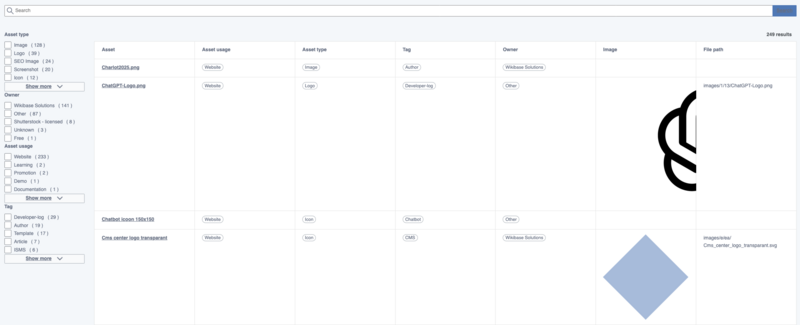
WikiSearch example screenshot
Powerful Faceted Search with custom search results


Tagging, metadata, and “content types”

SharePoint considerations

  • Metadata quality typically depends on disciplined usage across teams; without governance, classification becomes inconsistent.
  • Building structured experiences often requires aligning content types, columns, managed metadata, and page layouts across multiple sites.

Wikibase Solutions CSP strengths

  • Structured metadata can be applied consistently to both pages and files.
  • Content models can be implemented and updated using configuration patterns, enabling faster iteration and better alignment with evolving requirements.
  • Extensions such as FlexForm and WSSlots support structured authoring and repeatable page patterns across domains.


Customization and long-term maintainability

SharePoint considerations

Requirements beyond standard intranet and document collaboration can drive more complex solutions involving specialist skills, platform constraints, and ongoing maintenance.

Wikibase Solutions CSP advantages

  • Many changes can be delivered as configuration rather than bespoke platform engineering.
  • Open-source extensions reduce dependency on proprietary implementations and support a roadmap aligned to business needs.


Versioning, auditability, and change over time

Wikibase Solutions CSP provides strong revision history and transparent evolution of content and structures. This is beneficial in environments where information models change over time and traceability is important.


Permissions and governance (WikiGuard)

WikiGuard provides an advanced policy-based permission system:

  • Policies can be applied globally, per namespace, or per page.
  • Rules are evaluated in order to determine access for actions such as view/edit/delete.
  • Permissions are enforced.
  • Identity-provider aligned access control (OpenID Connect): Users can be authenticated via OpenID Connect, and role/group claims from Microsoft (e.g., Entra ID/Azure AD) can be mapped to MediaWiki user groups.


Working together with SharePoint and Microsoft 365

Many organizations use SharePoint and Microsoft 365 as a collaboration and productivity layer, while using Wikibase Solutions CSP as the structured knowledge layer. Wikibase Solutions CSP can integrate with SharePoint in multiple ways, enabling a “best of both worlds” approach rather than a forced replacement.

Typical integration patterns include:

  • Search integration: Publish selected wiki page signals (title, summary, tags/metadata, and the canonical link) into the Microsoft ecosystem (e.g., Microsoft Graph / Microsoft Search), so users searching in SharePoint can also discover relevant wiki pages and navigate directly to the source-of-truth content.
  • Content synchronization: On page create/update/delete, push changes (or references/links) to downstream systems for visibility, indexing, or communication workflows.
  • Document bridging: Read or reference documents stored in SharePoint and present them in the wiki context (e.g., show SharePoint documents inside wiki pages, enrich them with structured metadata, and include them in WikiSearch lists and curated views).
  • Unified identity and governance: Leverage Microsoft identity (OpenID Connect) and group/role claims aligning access control across platforms.
  • Intranet surfacing: Embed curated wiki-driven lists, knowledge summaries, or “latest updates” blocks into SharePoint pages, while maintaining the underlying content in Wikibase Solutions CSP.


This enables a pragmatic operating model: SharePoint remains excellent for Microsoft document collaboration and intranet delivery, while Wikibase Solutions CSP improves knowledge structure, discoverability, reuse, and long-term maintainability.


Document management: not limited to a “knowledge hub”

Wikibase Solutions CSP is also effective for document management, especially where discoverability depends on metadata and classification:

  • Each file can have a structured metadata profile (owner, status, domain, lifecycle, region, product line, etc.).
  • WikiSearch can build auto-updating lists of documents/pages and display them in business-specific layouts via templates, including optional actions.


Selection guidance

Choose SharePoint when the primary requirement is Microsoft 365 document collaboration and intranet publishing.
Choose Wikibase Solutions CSP when the priority is structured knowledge and document discovery, flexible information modeling, faceted search, configurable experiences, and fine-grained permission policies with security-trimmed results.

In many environments, the optimal approach is a combination: SharePoint for collaboration surfaces and Microsoft documents, and Wikibase Solutions CSP for the organization’s structured knowledge and metadata-driven discovery.


Comparison chart (Knowledge Base, DMS, ISMS, etc)

Capability Wikibase Solutions CSP Microsoft SharePoint
Open source
No license cost
No vendor lock
Self-manageable (hosting/control) ⚠️
Microsoft 365 / Office document co-authoring ⚠️
Document management (metadata-driven catalogs)
Wiki experience (true wiki workflows & reuse) ⚠️
Tagging & classification consistency ⚠️
Structured data + free text on same page ⚠️
Semantic / knowledge graph fit ⚠️
Smart search with facets/filters ⚠️
Dynamic lists from tags/metadata (auto-updating) ⚠️
Custom rendering of results (templates + actions) ⚠️
Customization speed (new “types”, layouts, flows) ⚠️
Schema evolution over time ⚠️
Revision history transparency ⚠️
Fine-grained access control ⚠️
Security-trimmed search results
Custom notifications
Responsive UI
Workflow / approvals

Next step

If you want to see how this fits your processes, we can map your use cases to a working structure and search experience.
Request demo

Wikibase stack.png

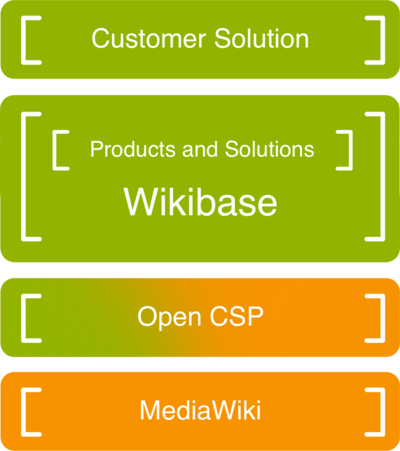
The Wikibase stack

The Wikibase stack builds on MediaWiki.

With Open CSP MediaWiki is turned into an enterprise level Content Services Platform.

Wikibase CSP is Open CSP with additional features that fit in our ecosystem.

Our current products:

The customer solution that fits like a glove.

Want to know more?
Lua error: bad argument #1 to 'mw.text.jsonDecode' (string expected, got nil).